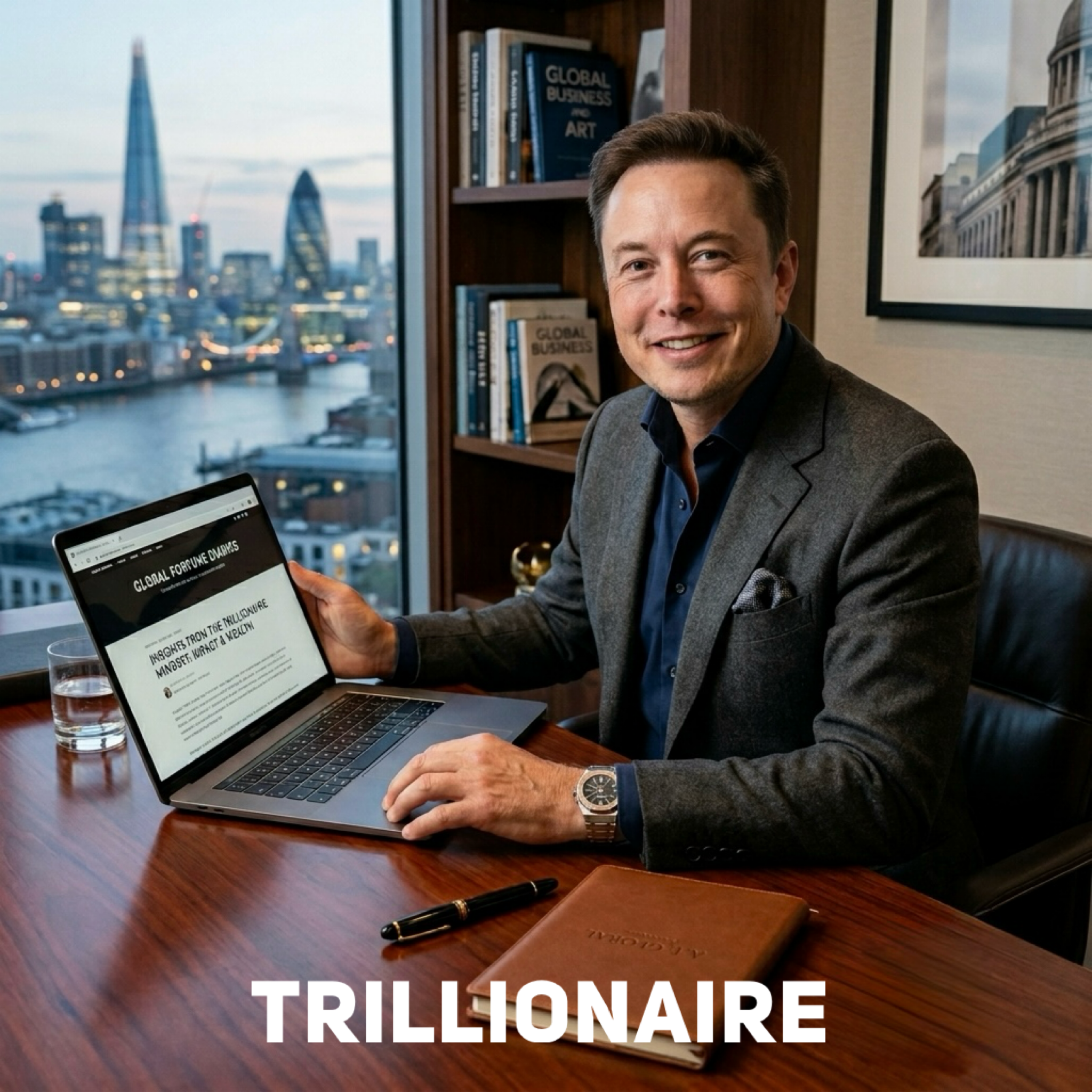
It happened. Or it’s about to. Depending on when you’re reading this, the ink is either drying or already dry on the most obscene financial milestone in human history. Elon Musk — the guy who runs four companies simultaneously while posting memes at 2 a.m. — is either already the world’s first trillionaire, or he’s close enough that the headline is inevitable. And most people shrugged. That’s the part that should terrify you. Not the number itself — though we’re going to spend a lot of time on the number, because most people genuinely cannot comprehend what $1 trillion actually means. The terrifying part is that we’ve been so thoroughly conditioned to accept incomprehensible wealth accumulation that we barely blinked. A man now controls more money than the GDP of most countries on Earth, and the discourse lasted about a news cycle before we moved on to whatever the algorithm fed us next. Let’s fix that. Right now. Let’s actually sit with this number until it makes you uncomfortable. $1,000,000,000,000. Read That Again. A trillion dollars. Twelve zeroes. Let’s break it down in ways that don’t let your brain slide off the surface. If you spent $1 million every single day, it would take you 2,740 years to spend $1 trillion. You would have started spending in 714 BC, somewhere around the founding of Rome, and you’d still be going today. The median American worker earns about $63,360 per year according to the U.S. Census Bureau. At that rate, it would take the average full-time American worker 15,782,828 years to earn $1 trillion. That’s roughly three times the age of the dinosaurs. That’s not hyperbole — the dinosaurs dominated Earth for about 165 million years, and even that wouldn’t be enough time for you to earn what one man now holds. Think about that the next time someone tells you that wealth is just a matter of working hard. If you laid $1 trillion in dollar bills end to end, the chain would stretch 96 million miles — past the Sun and back. The Sun is 93 million miles away. Musk’s net worth, in paper dollars, would wrap around our solar system. A stack of $1 trillion in $1,000 bills would be 67 miles high. Mount Everest is 5.5 miles. You’d need twelve Mount Everests stacked on top of each other to reach the top of that stack. Still not landing? Try this one. If Elon Musk decided to hand every single person on planet Earth a check right now — all 8.2 billion of us, including every child, every subsistence farmer, every person living in a mud hut in a flood zone — each person would receive about $121. That’s what $1 trillion divided by humanity looks like. A nice dinner. Maybe a week of groceries. How Did We Get Here? SpaceX went public this month at a valuation of $1.77 trillion. Musk owns roughly 42% of that company. Do the math. Combined with his Tesla holdings and his stakes in xAI and other ventures, the Bloomberg Billionaire Index had him at nearly $700 billion before the IPO even priced. The SpaceX debut on the Nasdaq pushed him past the line. Here’s the fun part: SpaceX’s own IPO prospectus — filed by the company’s own lawyers — warns that the company “has a history of net losses” and “may not achieve profitability in the future.” The company lost $4.94 billion in 2025 and was already burning through $4.28 billion in just the first quarter of 2026 alone. So we have the world’s first trillionaire, built substantially on a company that is actively losing billions of dollars, valued at $1.77 trillion — placing it among the ten most valuable companies in the world — despite generating revenue that would rank it roughly 200th among U.S. companies by actual sales. That puts it somewhere around General Mills in terms of real economic output. General Mills makes Cheerios. We didn’t crown a trillionaire for Cheerios. We did it for rockets that lose money and vibes. This isn’t an attack on aerospace or on the genuine engineering achievements of SpaceX’s workforce — those engineers are brilliant, and the technology is real. But the valuation is a fiction layered on top of real technology. And the trillionaire status built on top of that valuation is a fiction built on a fiction. What $1 Trillion Could Actually Do Here’s where the anger should crystallize into something sharp and specific. The entire federal budget for education in the United States is roughly $238 billion per year. One trillion dollars could fund American public education for four years with money left over. The United States has spent decades waging a so-called war on poverty. Since 1964, the federal government poured approximately $12 trillion into anti-poverty programs. That sounds enormous — until you realize we still have tens of millions of Americans living in poverty, and the poverty rate hasn’t budged much in 60 years. One man now holds roughly 8% of everything we’ve spent fighting poverty over six decades. Sitting in his pocket. Doing nothing for anyone who didn’t already have a brokerage account. About 37 million Americans currently live below the federal poverty line. $1 trillion divided among those 37 million people is roughly $27,000 each. That’s enough to completely transform a family’s life. Instead, it’s denominated in SpaceX shares held by one person who already has more money than any human being who has ever lived. According to economic historian Guido Alfani at Bocconi University, Musk’s fortune is now so enormous that he could theoretically command the labor of 557,800 workers simultaneously in 2025 terms. That’s the workforce of a mid-sized nation. One individual. One morning’s tweet about a meme coin moves markets. One evening’s mood affects the livelihoods of thousands of employees across multiple companies. This isn’t capitalism — it’s feudalism with better Wi-Fi. The Tesla Bonus That Broke Reality Before SpaceX even became the final nail in the coffin of normal numbers, Tesla’s shareholders approved a compensation package in November 2025 that would pay Musk $1 trillion in stock over ten years, on top of his existing fortune, if certain company benchmarks are hit. Stop. Read that again. His employees — the people building the cars, running the factories, managing the charging stations — are getting performance reviews and annual raises measured in the low single digits. Their CEO is in line for a performance bonus that, by itself, equals the entire GDP of the Netherlands. The Netherlands. An entire country. Bonus money. We are told the market sets these values. We are told this is the natural result of innovation and enterprise. We are told that wealth at this scale “trickles down.” After four-plus decades of supply-side economics, the median American worker still earns $63,360 a year. The gap between that and $1 trillion isn’t a gap anymore. It’s a geological formation. The Part Nobody Wants to Say Out Loud Here’s the thing about wealth at this scale that makes it fundamentally different from a guy with a successful plumbing business or even a regional chain of car dealerships. Wealth at $1 trillion is not just money. It is structural power over democratic systems. When you can lose billions on a vanity social media purchase, absorb the entire loss personally, and still end up richer than when you started — you are not subject to the same economic laws as the rest of us. When you can fund a political movement, install allies in government, receive enormous federal contracts through companies you own, and then receive further regulatory favors from the government you helped elect — that is not a free market. That is a feedback loop that has no democratic check. We are not watching capitalism succeed. We are watching what happens when capitalism has no guardrails and runs all the way to the wall. One person. One trillion dollars. No elected office. No term limits. No accountability to any voter. That should keep you up at night. “But He Built Things” Yes. He did. Or more accurately, he funded and led teams of brilliant engineers who built things. Tesla accelerated the EV market in ways that are genuinely significant. SpaceX has done things NASA couldn’t do with its budget constraints. These are real contributions. But here’s the question nobody is asking: at what ratio does contribution justify reward? If Elon Musk is 15 million times more productive than a median American worker — because that’s what the math requires to justify the gap — then we need to have an honest conversation about what “productive” means. Does any human being generate 15 million times more value than another human being? Does any human being generate 15,782,828 years’ worth of median American labor? Or is the system that produces this outcome simply broken? The answer, if you’re willing to say it plainly, is that no human earns a trillion dollars. A trillion dollars is what happens when the rules are written by the people who benefit most from the rules. It’s what happens when capital compounds faster than any wage can grow. It’s what happens when one person’s stock options are denominated in the same currency you use to buy groceries, but the two amounts have drifted so far apart they no longer exist in the same economic reality. What Comes Next Musk won’t be alone for long. Amazon’s Jeff Bezos, Oracle’s Larry Ellison, and Meta’s Mark Zuckerberg are all tracking toward the trillion-dollar mark within the decade if current trends hold. That’s four trillionaires. Walking among eight billion people. The Roman historian Pliny the Elder warned that large estates were ruining Rome. The concentration of agricultural land in the hands of a few patrician families was hollowing out the republic from the inside. He was right. It took a few hundred more years, but Rome fell. We are not saying Elon Musk is the fall of Rome. We are saying that when the gap between the wealthiest individual and the average person reaches a ratio that can only be described in geological time, something has gone structurally wrong. And the first step to fixing it is being willing to feel the appropriate amount of outrage instead of treating the headline like just another scroll. $1,000,000,000,000. One man. One number. Twelve zeroes. And roughly 8 billion people who got $121 each out of the deal. Get angry.