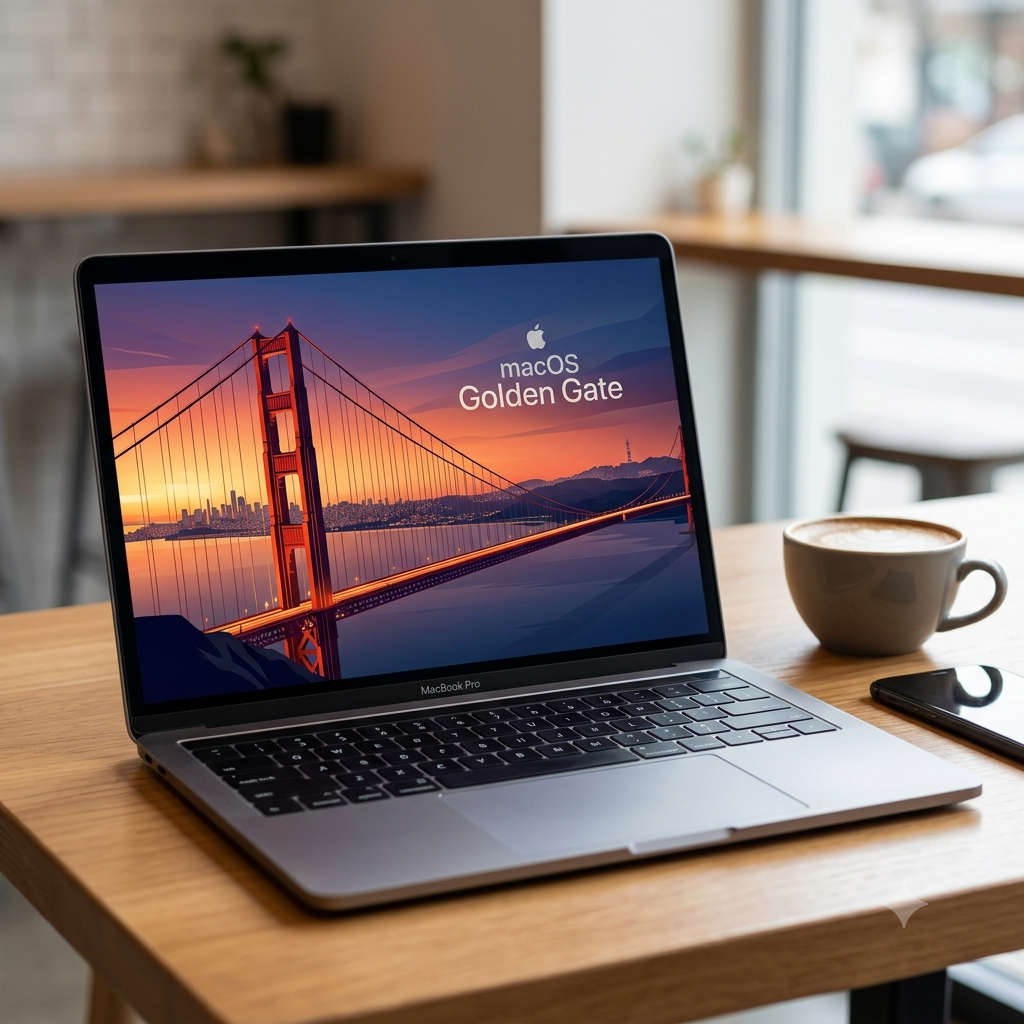
Apple just wrapped its WWDC 2026 keynote, and the headline software release of the year now has a name: Golden Gate. Technically, that name belongs only to macOS 27 — Apple still names its Mac releases after California landmarks, and this year it's the strait that connects San Francisco Bay to the Pacific. But in practice, "Golden Gate" has already become shorthand for the entire 2026 operating system family: iOS 27, iPadOS 27, macOS 27 Golden Gate, watchOS 27, tvOS 27, and visionOS 27. Same fall release window, same design language, same AI story running through all of it. So that's how we're going to treat it here — one suite, one strategy, one very loaded year for Apple. And it is a loaded year. This was Tim Cook's final WWDC as CEO before he hands the company to hardware chief John Ternus on September 1. It's the year Apple finally shipped — or at least demoed convincingly — the Siri it promised back in 2024 and then famously failed to deliver. It's the year Intel Macs get formally cut loose. And it's the year Apple quietly admitted, through a hundred small reversals, that last year's Liquid Glass redesign annoyed a lot of people. Let's get into all of it, because there's more going on under the surface of this "boring refinement release" than Apple's understated keynote let on. Quick housekeeping, because Apple's naming has gotten genuinely confusing. Last year Apple jumped its version numbers to match the year ahead — so the 2025 releases were the "26" family (macOS Tahoe was macOS 26). This year's releases are the "27" family, shipping in fall 2026 but branded for the year they'll spend most of their life in. Only the Mac gets a proper name on top of the number, and this year that name is Golden Gate. The choice of landmark feels deliberate. A bridge name for a bridge release: Golden Gate is the last macOS that will run x86 code through Rosetta 2 at full strength, and the first that won't run on Intel hardware at all. It connects the old Mac world to the new one, and then it closes the road behind it. Apple doesn't usually do symbolism by accident. The centerpiece of the whole keynote — across every platform — was Siri AI, a ground-up rebuild of the assistant Apple has been promising in one form or another since June 2024. To understand why this matters, you need the backstory: Apple announced a smarter, context-aware Siri at WWDC 2024, marketed iPhones around it, and then couldn't ship it. The delays got so bad that in May of this year, Apple reached a reported $250 million class-action settlement with iPhone buyers who argued they'd paid for AI features that never arrived on schedule. That's the cloud this announcement walked out under. So what did we actually get? Siri AI is a conversational assistant in the modern chatbot mold. You can talk to it or type to it, it holds real back-and-forth conversations with follow-up questions, and for the first time it lives in its own standalone app — a chat-thread interface that syncs across your devices through iCloud, much like you'd expect from ChatGPT or Gemini. It has on-screen awareness, which is the feature Apple has been teasing for two years: get a text with flight details, hold the side button, and tell Siri to add the flight to your calendar and text the arrival time to your mom. It reads the screen, does both, no copy-paste gymnastics required. It can chain multi-step commands in a single prompt, pull context from your email, messages, and photos, and answer live questions from the web with what Apple is calling "World Knowledge." Here's the part Apple said quietly and the press said loudly: the new Siri is powered by Google Gemini models under the hood. Apple Intelligence provides the privacy architecture and on-device orchestration, but the heavy lifting comes from a foundation model trained with Google's help. Strategically, this is fascinating and a little humbling. Apple spent two years trying to build this in-house, couldn't get it over the line, and ultimately did what it did with Maps data and search deals before: paid for the best available infrastructure and wrapped it in Apple's privacy story. Pragmatic? Absolutely. A great look for a company that prints money and employs some of the best engineers alive? Less so. On the Mac specifically, Siri AI integrates into Spotlight — type a query into Spotlight, and if it reads as an AI request, it gets routed to the assistant automatically. Visual Intelligence comes to the Mac too, letting you ask about anything on screen. On the Apple Watch, Siri AI brings genuine contextual understanding and follow-up questions to the wrist, which has historically been the place where Siri goes to embarrass itself. Now the asterisks, and there are several. Siri AI launches as an English-only beta later this year. It won't be available in China at all while Apple works through regulatory requirements there. And in the most consequential limitation, it won't ship on iPhones or iPads in the European Union at launch, because Apple is still wrestling with the Digital Markets Act. In a genuinely strange regulatory wrinkle, EU users will get Siri AI on the Mac, the Vision Pro, and the Apple Watch at launch — because those devices fall under different legal definitions than phones and tablets — just not on the two devices most people actually use. If you wanted a clean illustration of how messy the AI-regulation era is going to be, there it is. Hardware requirements are what you'd expect: iPhone 15 Pro and newer (plus all iPhone 16 models and later), any M1-or-better iPad or Mac, the A17 Pro iPad mini, Vision Pro, and on the watch side, Series 9 or later, Ultra 2 or later, and the SE 3 — with a compatible Apple Intelligence iPhone nearby to do the actual processing. The Mac release is where the most interesting decisions live, even though it's nominally the least flashy update in years. Start with the big structural change: Golden Gate is the first version of macOS that runs exclusively on Apple silicon. If you're still on an Intel Mac, macOS Tahoe is the end of the line for you — no Mac built before 2020 makes the cut. This isn't a surprise; Apple telegraphed it at last year's Platforms State of the Union when it laid out the end of the Intel transition. But it's still a milestone. Nearly two decades of x86 Macs, done. The companion announcement matters just as much for anyone running older software: Golden Gate is the last version of macOS with full Rosetta 2 functionality. Rosetta 2 is the translation layer that's been quietly running Intel-era apps on Apple silicon since 2020, and Apple is now putting an expiration date on it. If you have a legacy plugin, an old audio tool, a niche utility that never got an Apple silicon build — this is your final warning to find a replacement or freeze a machine on Golden Gate indefinitely. Anyone with a deep folder of older music software, scanning utilities, or business tools should take this seriously, because next year the safety net comes down. Then there's the design story, which is really an apology written in interface elements. Last year's macOS Tahoe brought Liquid Glass to the desktop, and the Mac faithful hated a lot of it — the translucency that wrecked readability, the inconsistent window corner radii, the general sense that the Mac was being styled by the iPhone team. Golden Gate walks an impressive amount of it back. Window border radii are uniform across apps again. Toolbars are uniform, sidebars run edge to edge, the menu bar icons got redrawn, and refraction is more consistent so text is actually legible on top of glass surfaces. The mouse cursor has been redesigned to echo the glove-style pointer from the pre-Tahoe era. And the headline concession: there's now a Liquid Glass slider in System Settings, letting you dial the effect anywhere from ultraclear to fully tinted. Apple even dropped the separate default wallpaper conceit. None of this is revolutionary. All of it is Apple saying "we heard you" without ever saying the words, and honestly, that's the most encouraging thing about this release. Under the hood is where Golden Gate earns its keep. Apple rebuilt the system search index, which should make Spotlight, Mail, and Photos — three places where search has been quietly broken or sluggish for years — faster and more reliable, with a new ranking system that puts relevant results on top. AirDrop transfers are quicker, network file browsing is faster, and Safari's start page loads more responsively. Safari can also group related tabs automatically now, and several iOS conveniences migrate over: pull-to-refresh arrives in Safari, Mail, News, Podcasts, and Calendar, and the iPhone Mirroring window is finally resizable. Individually, these are footnotes. Collectively, they're the release. More than one longtime Mac watcher has reached for the Snow Leopard comparison — the legendary 2009 release that shipped almost no new features and instead just made everything faster and more stable. Golden Gate isn't quite that pure (the Siri AI integration alone disqualifies it), but the spirit is similar: fix what's broken, refine what's ugly, stop piling features on a wobbly foundation. After the rocky Tahoe cycle, that's exactly the right call. If the Mac release is about cutting hardware loose, the iPhone release is the opposite story. iOS 27 supports every single device that ran iOS 26 — iPhone 11 and newer, no cuts at all. For a release this focused on AI, keeping a 2019 phone on the support list is genuinely commendable, even if the fancy Siri features remain gated to recent silicon. The performance pitch is concrete: app launches up to 30 percent faster, plus the same rebuilt search infrastructure as the Mac. There's a new "Search or Ask" panel — swipe down from the top center and you get a unified surface that can run shortcuts, search the phone, or hand a complex question off to a chatbot, including third-party ones. The Camera app gets a redesign with customizable controls. Apple Intelligence threads through the system apps: smarter tab management in Safari, one-tap password updating, cross-app context awareness, AI features in Photos and Wallet. And then there's the thing Apple didn't announce but couldn't hide: developers digging through the iOS 27 beta found references to fold states and hinge angles — the software scaffolding for a foldable device. Combined with years of foldable iPhone rumors, the smart money says September's iPhone event (the first of the Ternus era) is where that scaffolding gets a purpose. Watch this space. iPadOS 27 mostly rides along with the iPhone release, picking up the Siri AI overhaul, the performance work, and quality-of-life touches like undo and redo for Home Screen edits. The Apple Watch got almost no keynote stage time, which is a shame, because watchOS 27 is one of the more substantial updates in the suite — and one of the most consequential, because of what it leaves behind. The marquee change is a redesigned dynamic app grid that surfaces and rearranges five apps based on context and what you actually use, with the rest of your apps a tap away. There's a clever new gesture: tap your index finger and thumb together once to select a widget in the Smart Stack, so you can interact with the watch when your other hand is full of groceries or a trumpet. Smart Stack suggestions get more contextual — parked car location, birthday reminders for close contacts, transit card balances. You can build custom Wallet passes from any QR-code membership card. Find My finally consolidates Find Devices, Find Items, and Find People into one app. Workout Buddy gets AI-powered coaching upgrades, Messages picks up Live Translation on the wrist, and Siri AI brings real conversational ability to the watch for the first time. Now the cuts, and they're aggressive: watchOS 27 drops the Apple Watch SE 2, Series 6 through Series 8, and the original Ultra. That's five models gone in one release, including the SE 2 — a watch Apple was selling new not very long ago — and the first Ultra, a premium device from 2022. If macOS Golden Gate's Intel cutoff was long-telegraphed and fair, the watch cuts feel abrupt. Owners of a three-year-old, $799 Ultra have a right to be annoyed. The living room update is all about responsiveness: tvOS 27 claims app launches up to 30 percent faster, snappier animations and Apple Music playback, quicker Control Center interactions, and faster AirPlay handshakes between Apple TV, HomePod, and the rest of the ecosystem. Nothing dramatic, everything welcome. visionOS 27 brings the Siri AI experience to the Vision Pro — including, notably, in the EU at launch, where the headset escapes the regulatory net that catches the iPhone. Beyond the assistant, it follows the suite-wide theme of Liquid Glass refinement and performance work. Apple clearly views the headset as a slow-burn platform right now, and the software reflects that: steady, not splashy. Buried under the AI headlines is one of the most significant policy shifts in the suite: a top-to-bottom rebuild of parental controls across every platform. Child accounts become mandatory for users under 13. Parents get a redesigned dashboard in System Settings — yes, on the Mac too, which now participates fully in the ecosystem-wide child protection system — with at-a-glance usage summaries and the ability to adjust app access in the moment with a click. Safari gains website-approval tools, so parents can whitelist rather than chase blocklists. In a year when governments on multiple continents are legislating child online safety, Apple building this directly into all six operating systems is both good product design and shrewd regulatory positioning. It's the kind of feature that doesn't trend on launch day and quietly matters for a decade. One more thing worth flagging, because it says something about where Apple's head is at. Midway through the keynote, Apple flashed one of its trademark wall-of-text slides — this one packed with more than 250 smaller features and refinements spread across all six operating systems. The internet, naturally, paused the stream and transcribed the whole thing. The list is a grab bag of exactly the unglamorous stuff power users have been requesting for years: web audio that no longer interrupts system audio, more seamless handoffs between Wi-Fi and cellular, faster AirPlay connections, the ability to switch between two iPhones sharing the same phone number, smarter Spotlight suggestions, undo and redo for Home Screen edits on iPad, and a stack of new keyboard languages from Afrikaans to Guarani. None of it sells a single device. All of it is the connective tissue of a platform that's being maintained rather than merely marketed, and after the past couple of years, that distinction matters. The keynote itself broke from Apple's usual structure, too. Instead of the traditional platform-by-platform march — iOS, then iPadOS, then macOS, and so on down the line — Apple organized the presentation around AI capabilities and told the story of iOS 27, iPadOS 27, and macOS Golden Gate through the lens of what Siri AI and Apple Intelligence can do across them. watchOS and tvOS barely got stage time at all, with their substantial updates relegated to press releases and developer documentation dropped after the show. You can read that two ways. The charitable read: Apple is finally presenting its platforms as one coherent system rather than six separate products, which is how people actually live with them. The cynical read: Apple needed every available minute to convince the world that Siri is real this time. Both things can be true. It's worth pausing on the corporate subtext, because it shaped this entire release. Tim Cook ran his last WWDC keynote, with John Ternus — Apple's senior VP of hardware engineering — taking the CEO chair on September 1. Reading Golden Gate through that lens, the strategy gets clearer. This is a clean-the-decks release: settle the Siri lawsuit, ship the Siri rebuild (even if it took Google's models to do it), finish the Intel transition, fix the design controversy, rebuild the creaky search plumbing. Cook is handing Ternus a tidied house. Whatever bold swings come next — the foldable the iOS 27 beta keeps whispering about, the next phase of Apple Intelligence — they'll happen on the new CEO's ledger, starting from a stable base. As succession planning goes, it's almost suspiciously tidy. Developer betas of all six operating systems are available now. Public betas should land in July, following Apple's usual cadence, with the full releases expected this fall — September for the iPhone-adjacent platforms, with macOS Golden Gate likely arriving in October. All of it is free on compatible hardware, as always. So, the verdict. Golden Gate is not an exciting release, and that's precisely its virtue. After two years of Apple over-promising on AI and under-delivering on polish, this is the suite where the company stopped performing and started fixing: real performance gains, a search system that might finally work, a design language tuned to what users actually asked for, and an assistant that — courtesy of a humbling Google partnership — might at last do the things Apple put in commercials two years ago. The Intel cutoff and the watch cuts will sting for some, and the EU Siri situation is a mess of Brussels' and Cupertino's joint making. But as a foundation for the post-Cook era, Golden Gate does exactly what its namesake does: it gets you across. The bar for fall is simple. Siri AI has to actually work, in shipping software, on real people's devices. Apple has spent its benefit of the doubt. Golden Gate is the company's bet that boring competence wins it back — and for once, that feels like the right bet.First, the Name Game
Siri AI: The Apology Tour Becomes a Product
macOS 27 Golden Gate: The Intel Funeral and the Liquid Glass Climbdown
iOS 27 and iPadOS 27: Speed, and Mercifully No Casualties
watchOS 27: Big Features, Brutal Cuts
tvOS 27 and visionOS 27: The Quiet Corners
The Parental Controls Overhaul Nobody's Talking About Enough
The 250-Feature Slide and a Keynote That Broke Format
The Ternus Transition Hiding in Plain Sight
When You Can Get It, and Whether You Should Care