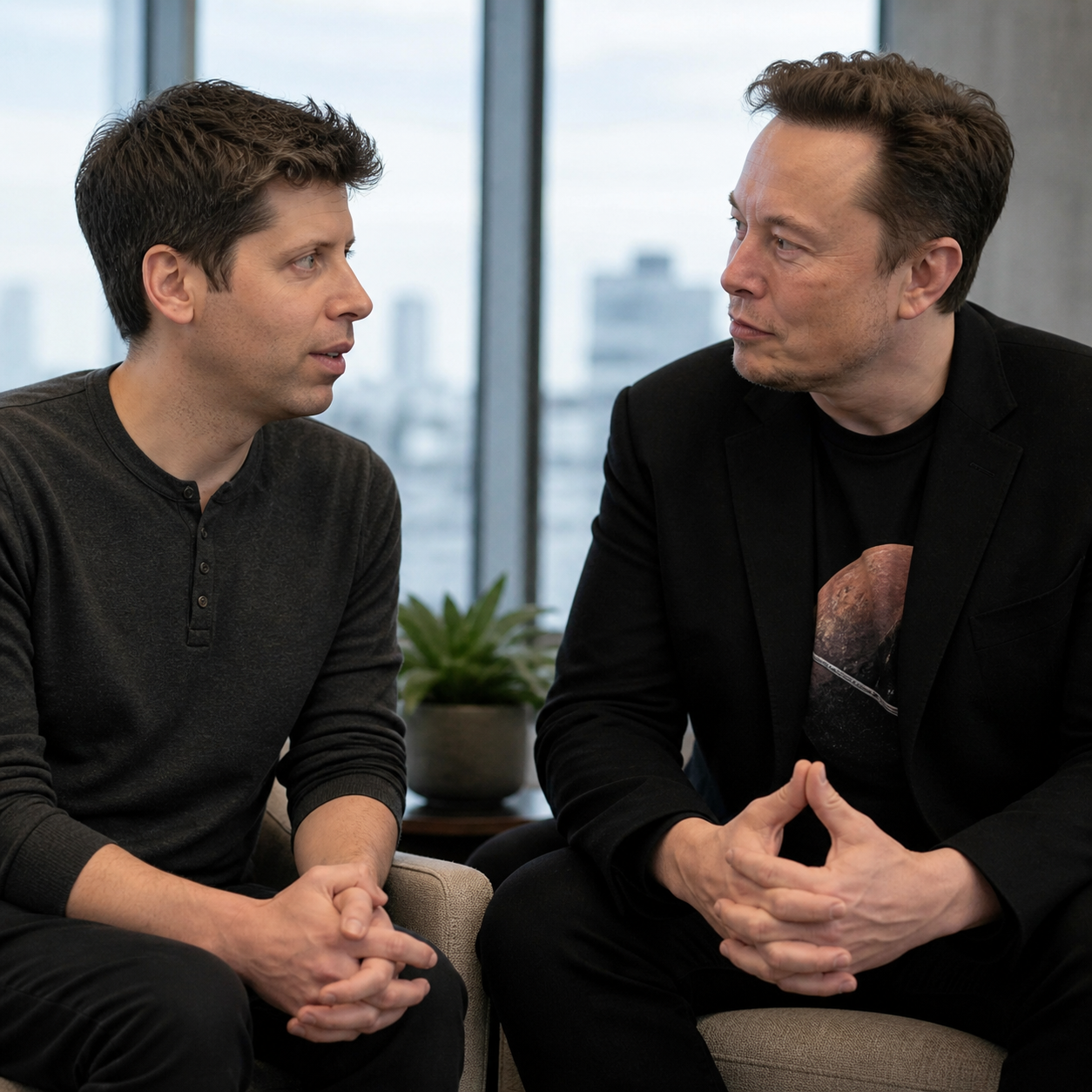
A tech world trial where the subtext matters more than the statements There are moments in tech where it stops being about products, launches, or even money—and turns into something closer to theater. Not the polished kind, either. More like a courtroom drama where every line is calculated, every pause intentional, and nobody is really saying exactly what they mean. That’s where things are right now between Elon Musk and Sam Altman. Call it a legal dispute, call it a philosophical split, call it a power struggle dressed up in policy language—it’s all of those at once. But if you strip it down, it comes across like something simpler: Two people who once pointed in the same direction… now arguing about what that direction ever was. It’s easy to forget how aligned they once were. Back in the early days of OpenAI, the pitch was almost idealistic: build artificial intelligence responsibly, keep it from concentrating power, and make sure it benefits humanity broadly. That wasn’t marketing fluff—it was the foundation. But somewhere along the way, the paths diverged. Musk stepped away. Altman stayed and built. And now, years later, they’re effectively arguing over what OpenAI was supposed to become—and whether it crossed a line. When you look at the public statements, what stands out isn’t just disagreement—it’s tone. There’s a subtle shift from technical critique to something more personal. At one point, Musk framed the situation bluntly: > “OpenAI was created as an open-source, non-profit company to counterbalance Google. Now it’s a closed-source, maximum-profit company effectively controlled by Microsoft.” That’s not just criticism—that’s a claim of betrayal. Not illegal, necessarily. But ideological. Altman, on the other hand, tends to respond in a way that feels calmer on the surface… but still pointed: > “We are focused on building safe and beneficial AGI. That requires massive resources and partnerships.” Notice what’s happening there. He doesn’t directly refute Musk’s framing. He reframes the necessity. Different strategy entirely. Musk says: You changed the mission. Altman says: The mission required change. That’s the core conflict, right there. Legally, it’s about structure, governance, and whether OpenAI adhered to its original commitments. But practically? It’s about control over the most important technology of the next 50 years. You don’t go to court over philosophy alone. There’s always something underneath it. In this case: - Who gets to define “safe AI” - Who controls the infrastructure - Who profits (and how much) - And maybe most importantly—who gets to decide the pace of development Musk’s angle leans toward caution mixed with control. He’s been consistent about existential risk, sometimes to the point of sounding alarmist. Altman’s position feels more like managed acceleration. Build it—but try to steer it. Neither position is simple. And neither is clean. Here’s the part that doesn’t get quoted as much. Musk has built companies by owning the stack—from hardware to software to distribution. He doesn’t like being on the outside of something that big. Altman, meanwhile, has positioned himself inside one of the most powerful partnerships in tech, with deep integration into Microsoft. So when Musk criticizes OpenAI, it’s not just philosophical—it’s also structural. And when Altman defends it, he’s not just explaining—it’s also reinforcing the current power model. That’s why the conversation feels tense even when the words sound measured. It’s tempting to treat this like just another tech feud. Silicon Valley has plenty of those. But this one’s different. Because AI isn’t just another platform shift—it’s a foundational layer. The outcome of these disagreements will shape: - How open or closed future systems are - Whether independent players can compete - How much influence a few companies end up having This isn’t about social media or smartphones. This is infrastructure for thinking machines. If you’re expecting a clear winner here, you’re probably going to be disappointed. Even if one side “wins” legally, the broader questions don’t go away: - Can you build advanced AI without massive capital? - Can you keep it open without losing control? - Can you scale responsibly without compromising ideals? There’s no neat answer. And that’s why the back-and-forth—this “he said, he said”—keeps going. What makes this situation interesting isn’t just what’s being argued. It’s what’s being revealed. You’re seeing, in real time, how the people building the future of AI actually think about power, responsibility, and control. Not in a keynote. Not in a blog post. But under pressure. And when you listen closely, you start to realize something: They’re not just disagreeing about what AI should be. They’re disagreeing about who gets to decide.The Setup: Same Origin, Different Endgame
The Quotes That Say More Than They Should
What This “Trial” Is Really About
The Subtext Nobody Says Out Loud
Why This Matters More Than It Looks
The Reality: Nobody “Wins” Cleanly
Final Thought