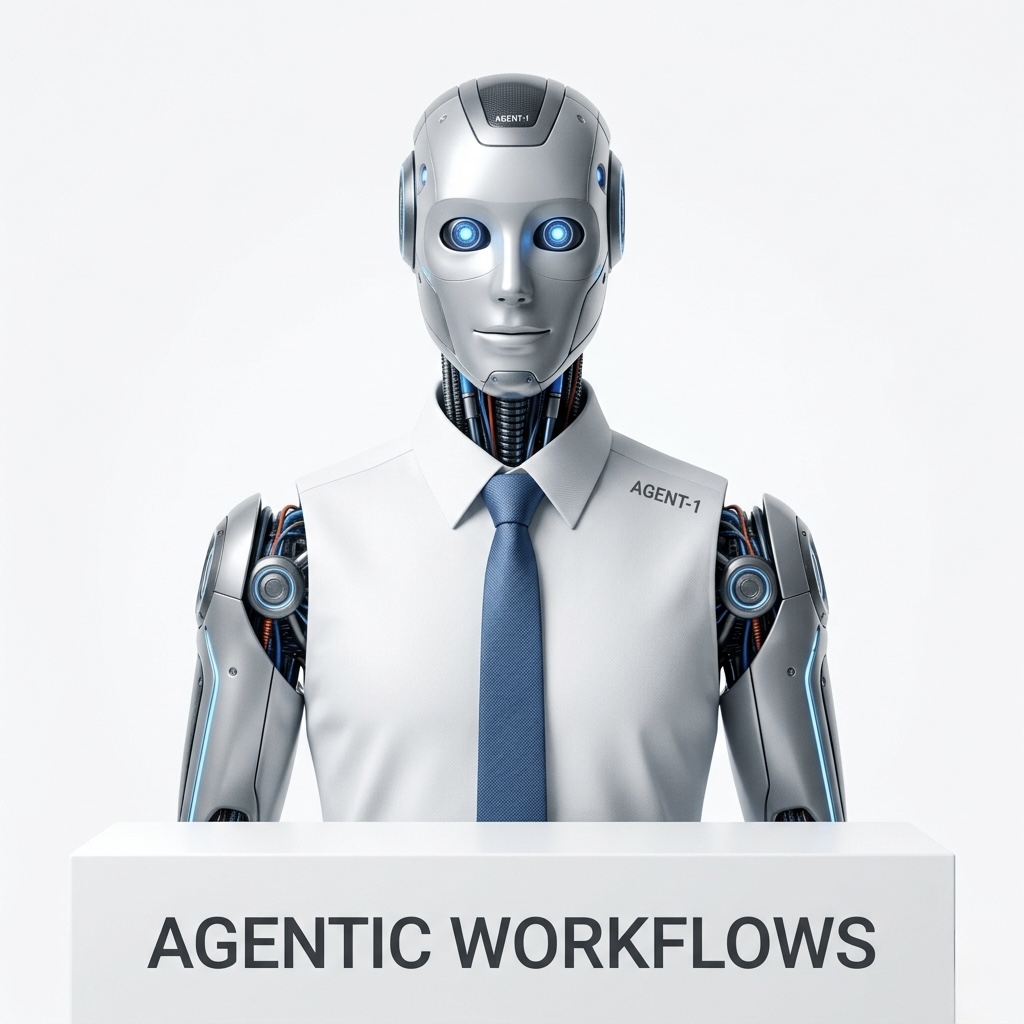
We’ve officially moved past the honeymoon phase of artificial intelligence. If the last few years were about marveling at chatbots that could write a sonnet or summarize a PDF, today’s reality is much more pragmatic—and significantly more powerful. We are no longer just talking to AI; we are assigning it jobs.
Enter the agentic workflow.
If you've been paying attention to the enterprise software space recently, you've likely heard the term. But what exactly separates an "agentic workflow" from the conversational AI we’ve grown accustomed to?
Traditional Generative AI operates on a prompt-and-response model. You ask a question, and it gives you an answer. It requires a human in the loop at every single turn. An agentic workflow, however, shifts the paradigm from prompt-based computing to goal-based computing. You give an AI agent an objective, and the agent autonomously breaks that objective down into steps, gathers the necessary data, utilizes external tools (like APIs, CRMs, or databases), evaluates its own progress, self-corrects if it hits an error, and executes the final action.
It is the difference between having a super-powered encyclopedia and having a relentless, digital project manager.
In this post, we will explore exactly how organizations are utilizing agentic workflows to get work done today, and extrapolate what the landscape will look like in three, six, and nine months as this technology scales.
How People Are Using Agentic Workflows Today
Right now, agentic AI is not science fiction; it is actively transforming back-office operations, software engineering, and customer service. The areas where agents are delivering the most measurable value share common traits: they involve high-volume, repetitive decisions, multi-step processes that span across different software systems, and tasks where speed and accuracy trump human novelty.
Here are the concrete ways agentic workflows are operating in the wild today:
1. Autonomous Financial Reconciliation and Billing
In the financial sector, agentic AI has moved far beyond simple data entry. Companies are deploying agents to handle end-to-end billing, expense reporting, and contract compliance.
- The Workflow: An invoice arrives in a shared inbox. An Invoice Data Agent automatically detects it, downloads the attachment, reads and extracts the line-item data. It doesn't stop there. The agent then logs into the company's enterprise resource planning (ERP) system, checks the invoice against original purchase orders, validates the math, and flags missing fields. If everything matches, it stages the payment for final human approval. If there is a discrepancy, the agent can draft an email back to the vendor asking for clarification.
- The Impact: Firms are processing thousands of vendor contracts and invoices in minutes, virtually eliminating manual rekeying errors and functioning essentially as a tireless junior accountant.
2. Software Engineering and IT Service Management
Software development has arguably seen the most aggressive adoption of agentic AI.
- The Workflow: A developer opens a ticket in Jira outlining a bug in a web application. An engineering agent detects the new ticket, pulls the relevant repository from GitHub, and sets up a localized testing environment. It runs the code to reproduce the bug. Once identified, the agent writes a patch, runs the internal test suite to ensure the fix didn't break anything else, and submits a pull request with a detailed summary of the changes.
- The Impact: Human developers are shifting from writing boilerplate code and hunting down syntax errors to reviewing architecture and acting as editors for AI-generated solutions. Furthermore, in IT Operations, agents are autonomously monitoring networks, detecting VPN anomalies, provisioning software for new employees, and resolving tier-1 helpdesk tickets without human intervention.
3. Supply Chain and Inventory Orchestration
Global logistics is an incredibly complex web of moving parts, making it a perfect candidate for agentic optimization.
- The Workflow: An agentic AI monitors real-time inventory levels, weather patterns, and global shipping data. It detects that a crucial component for a manufacturing line is delayed at a port. The agent automatically calculates the impact on production, checks alternative suppliers, cross-references their current pricing and delivery times, and autonomously places a reorder with a backup supplier to prevent a line stoppage.
- The Impact: Supply chains are becoming resilient and predictive rather than reactive. Agents manage demand forecasting and warehouse automation, ensuring stock levels remain optimal without a supply chain manager constantly refreshing a dashboard.
4. End-to-End Customer Service Resolution
We all know the frustration of dealing with a rigid, rules-based chatbot. Agentic workflows have fundamentally changed this dynamic.
- The Workflow: A customer messages a retailer about a missing package. Instead of just giving the customer a tracking link, the customer service agent connects to the shipping API, realizes the package was delivered to the wrong state, connects to the warehouse inventory system to verify a replacement is in stock, connects to the order management system to initiate the replacement order, and finally responds to the customer confirming that a new package is on the way, along with a newly generated tracking number.
- The Impact: Customer service is transformed from a static FAQ function into a proactive problem-solving engine, dramatically lowering ticket resolution times and boosting customer satisfaction.
The Horizon: Extrapolating the Next 9 Months
The pace of AI development is notoriously relentless. If today is about automating siloed, multi-step tasks within specific departments, the next nine months will be characterized by integration, security governance, and multi-agent collaboration. Here is a concrete look at what is coming.
3 Months Out: The Rise of Agentic Identity and Governance
As enterprise adoption scales, the immediate bottleneck isn't the intelligence of the AI, but trust and security. If an AI agent has the power to spend company money, access customer databases, and push code to production, IT departments need absolute control over what these agents are allowed to do.
- The Extrapolation: In three months, the primary focus will be on Agentic Identity and Access Management (IAM). We will see the widespread implementation of systems like the Model Context Protocol (MCP) Gateways.
- Concrete Example: A mid-sized marketing firm deploys an agent to manage its advertising budget. Instead of giving the agent a human employee's login credentials (a massive security risk), the IT department issues the agent its own verified digital identity. Through a zero-trust gateway, the agent is granted "least privilege" access. It can pull performance metrics from Google Ads and adjust bids, but the gateway strictly blocks the agent from accessing the HR database or exporting client lists. Security teams will monitor agent activity on dashboards exactly as they monitor human employee activity, killing the agent's access instantly if it begins executing unauthorized commands.
6 Months Out: Multi-Agent B2B Ecosystems
By the six-month mark, we will move past single agents operating within a single company. We will enter the era of multi-agent systems—and more importantly, agents negotiating with other agents across organizational boundaries.
- The Extrapolation: Gartner predicts a massive surge in enterprise applications featuring embedded, task-specific AI agents. Because major platforms (like Salesforce, SAP, and Workday) will be natively agentic, these systems will begin communicating directly with one another without requiring a human bottleneck.
- Concrete Example: A procurement agent at a manufacturing company (Company A) realizes inventory is low. Instead of emailing a human sales rep at a supplier (Company B), Company A's agent directly pings Company B's sales agent. The two agents negotiate bulk pricing and delivery timelines based on their respective internal constraints and historical pricing data. They agree on terms, autonomously draft the contract, route it for final human signature, and update both companies' ERP systems simultaneously. Routine B2B transactions will become instantaneous digital handshakes between algorithms.
9 Months Out: Predictive Edge Operations and "Virtual Executives"
Nine months from now, agentic workflows will begin to move from operational support to strategic execution. Models will become highly proficient at anticipating needs before they are articulated, effectively acting as autonomous middle-management or specialized "virtual executives."
- The Extrapolation: Agents will run continuously in the background, reasoning over massive streams of multimodal data (text, video feeds, market trends, IoT sensor data) to dynamically optimize entire business units.
- Concrete Example: A retail company deploys a Virtual Supply Chain Executive. This agent doesn't just wait for a ship to be delayed; it ingests geopolitical news, local labor union strike data, and global weather patterns. The agent predicts an 80% likelihood of a port strike in Long Beach three weeks before it happens. Autonomously, the agent decides to re-route incoming shipments to Seattle. It dynamically updates pricing on the e-commerce website to reflect the slightly higher shipping costs, pauses marketing campaigns in regions that will experience inventory shortages, and drafts a comprehensive memo to the human executive team explaining the actions it took and the projected financial impact.
The Road Ahead
The transition to agentic workflows represents a fundamental reorganization of how human labor interfaces with technology. We are transitioning from a world where humans do the computing, to a world where humans manage the computing.
Today, organizations are using these workflows to cut costs, reduce manual errors, and speed up routine processes like invoice reconciliation and code debugging. But as we look 3, 6, and 9 months into the future, the technology will evolve from simple automation into autonomous, strategic orchestration. The companies that thrive will not be those that simply buy the most AI, but those that design the most resilient, secure, and integrated workflows for their digital workforce to operate within.