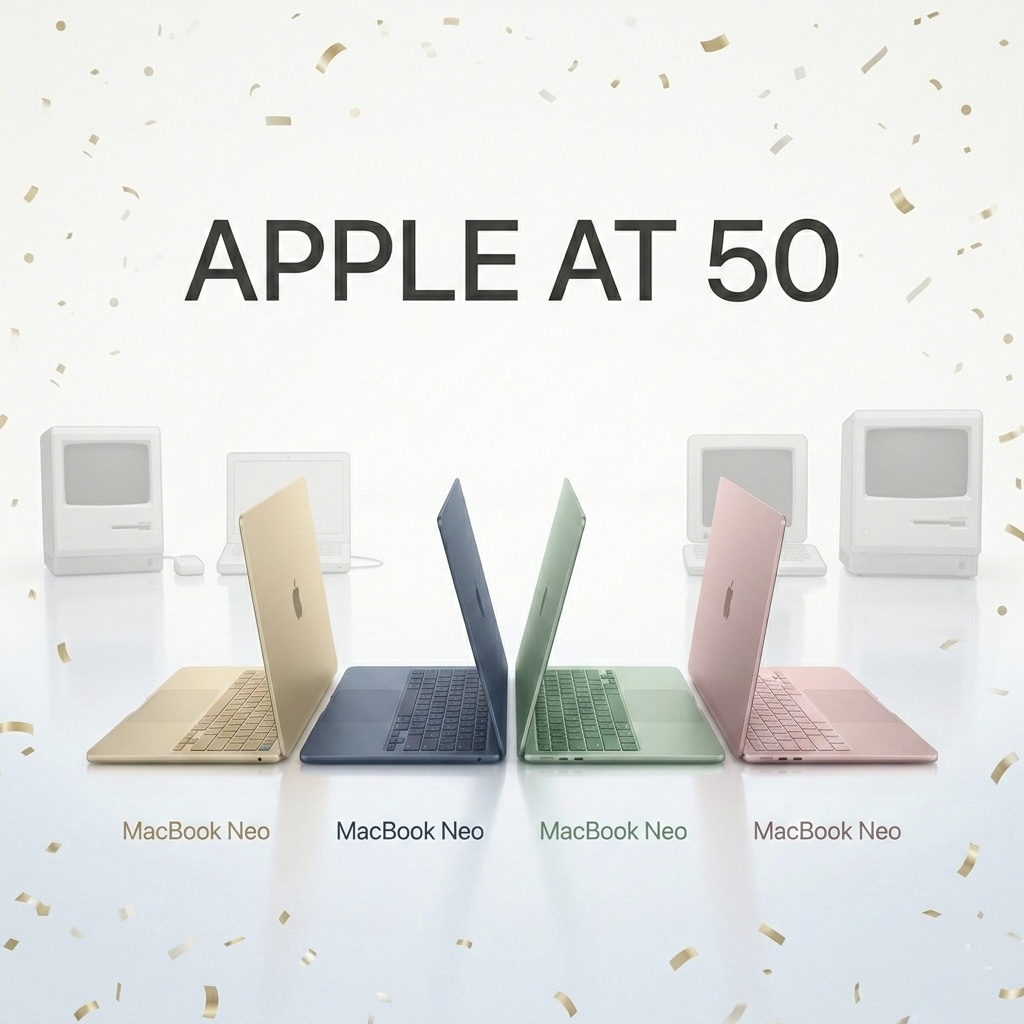
As Apple approaches its 50th anniversary on April 1, 2026, it stands as a $3.7 trillion titan, a long way from its humble origins in a California garage. Its history is a narrative of radical disruption, from the original Macintosh to the iPhone. While many anticipated a high-end collector's item or a futuristic leap to celebrate five decades, Apple instead launched the MacBook Neo, a $599 laptop that directly challenges the brutal and unforgiving budget PC market. For years, the phrase "cheap Apple computer" was an oxymoron. Users wanting a Mac under $1000 had to rely on years-old models, often sold through third-party retailers. The Neo changes everything. It is a new entry point, designed from the ground up to bring the Mac experience to a massive, previously untouched audience. It’s not just a product; it is a declaration that the "Walled Garden" is now open to everyone. The most immediate disruption is the price. At $599 (and an even more aggressive $499 for education), the Neo creates a new floor for the Mac. Apple's competitors have taken note. During a recent earnings call, ASUS Co-CEO S.Y. Hsu called the launch a "shock to the entire market," noting that major players like Microsoft, Intel, and AMD now have to "seriously discuss how to compete with this product." Historically, the sub-$600 market has been the domain of Windows laptops with compromise-ridden build quality and Chromebooks limited by their operating system. The Neo shatters this paradigm. It features a stunning 13-inch Liquid Retina display, a durable, beautiful aluminum unibody design in vibrant colors like Citrus and Indigo, and up to 16 hours of battery life. The secret to this "impossible" product lies in its silicon. Instead of using a de-tuned computer chip, the Neo is powered by the A18 Pro, the exact same SoC found in the iPhone 16 Pro. The decision to use a "phone chip" has created a unique narrative. Some critics have questioned its productivity potential. However, early reviews and benchmarks have been overwhelmingly positive, proving that Apple's A-series chips are formidable. Of course, to hit this price point, Apple made choices. The base Neo comes with 8GB of unified memory and 256GB of storage. The trackpad is mechanical, lacking the haptic feedback of its premium siblings, and there is no keyboard backlight or Touch ID on the entry model. Yet, as a review on Thurrott.com summarized, "No compromises here from a usage perspective, you get the full customization of the macOS experience." The MacBook Neo is more than a budget laptop; it's a strategic masterstroke. It lowers the barrier to entry, welcoming first-time laptop owners, students, and Windows enviers. With Screen Time and parental controls, it becomes a critical link for families. As Apple enters its second half-century, the Neo proves that it can still think differently, engineering progress one "insanely great" (and affordable) product at a time.The "Shock" of Affordability
Performance and Punditry
The Next 50 Years