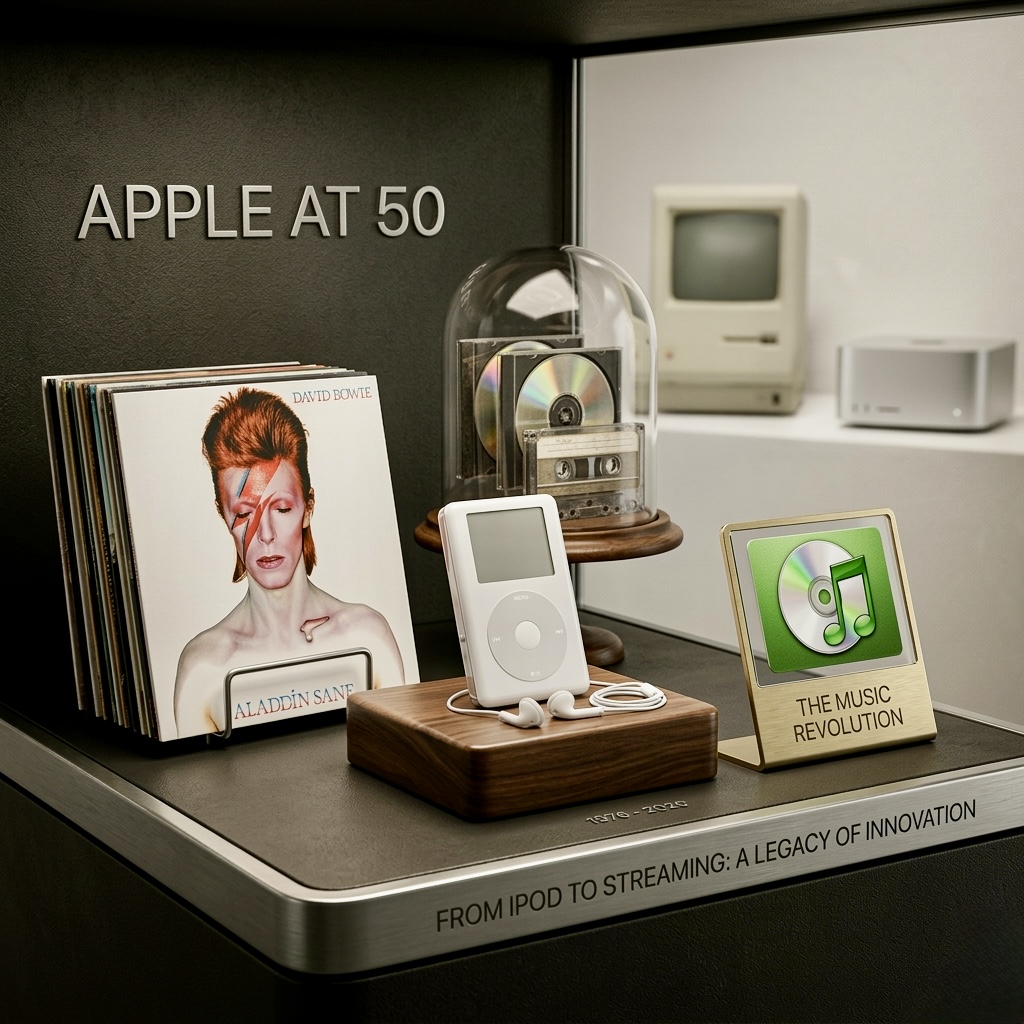
As Apple marks its 50th anniversary, the company’s history is often divided into two distinct eras: before the iPod, and after. While Apple was founded in 1976 on the promise of the personal computer, it was the digital music revolution of the early 2000s that transformed a struggling tech company into a global cultural titan. At the absolute center of this transformation was one of the most vital creative partnerships in modern history: the mind-meld between CEO Steve Jobs and Chief Design Officer Jony Ive. When Steve Jobs returned to Apple in 1997, the company was weeks away from bankruptcy. Its product line was a bloated, confusing mess. But in a windowless studio on the first floor of Apple’s Infinite Loop campus, Jobs found a kindred spirit in a young British designer named Jony Ive. Jobs and Ive shared a fundamental, almost obsessive philosophy: true design wasn't just about how something looked, but how it worked. They believed in stripping away the non-essential until only the purest expression of a product remained. Ive’s design studio became a sanctuary for Jobs—a place where the two men would spend hours touching prototypes, debating materials, and agonizing over the curve of a corner or the tactile click of a button. In 2001, the digital music landscape was chaotic. Existing MP3 players were bulky, held only a handful of songs, and featured user interfaces that felt like navigating a spreadsheet. Jobs tasked Ive’s team with wrapping a massive 5GB hard drive—capable of holding "1,000 songs in your pocket"—into a device people would actually want to carry. Ive responded with a masterclass in minimalist industrial design. The original iPod was devoid of the cheap black plastics that dominated the electronics industry. Instead, Ive utilized dual materials: a pristine, stark white polycarbonate front seamlessly joined to a mirror-polished stainless steel back. But the true genius born during the iPod's creation—the Click Wheel—actually originated outside the design studio. Jobs knew that scrolling through a thousand songs with traditional up-and-down buttons would be a nightmare. The breakthrough arrived when Apple's head of marketing, Phil Schiller, brought a Bang & Olufsen cordless phone remote (the BeoCom 6000) into an early meeting with Jobs and Ive. Schiller demonstrated how the elegant Danish device used a physical wheel to quickly and effortlessly scroll through a long list of contacts. Ive and his team took that brilliant mechanical inspiration and flawlessly executed it for the iPod. The continuous, circular scrolling mechanism created an intuitive, tactile experience that felt entirely natural, merging hardware and software perfectly. Furthermore, Ive made the deliberate choice to make the earphones white. In a sea of black wires, those white cables became an instant, silent billboard. You didn't even need to see the device to know someone was listening to an iPod. Beautiful hardware was only half the equation. Jobs understood that the software experience had to be just as elegant. Before iTunes, acquiring digital music meant dealing with the legal risks and malware of peer-to-peer sharing sites like Napster, or wrestling with clunky CD-ripping software. Jobs ruthlessly negotiated with the major record labels to create the iTunes Store in 2003, offering a revolutionary proposition: any song, legally, for 99 cents. The integration was flawless. You bought a song on iTunes, plugged in your iPod, and it simply synced. No file dragging, no format conversions. It was the ultimate manifestation of the Jobs-Ive philosophy applied to a software ecosystem: it just worked. The iPod and iTunes did more than save the music industry from piracy; they redefined Apple's DNA. The success of this pocket-sized music player proved that consumers craved technology that sat at the intersection of the liberal arts and engineering. Looking back over 50 years, the iPod stands as the ultimate testament to the collaborative environment Jobs and Ive built. By obsessing over the details, drawing inspiration from unlikely sources, and refusing to compromise on simplicity, they didn't just design a music player. They designed the foundation for the iPhone, the iPad, and the modern mobile era.The Sanctuary of the Design Studio
Designing the Object of Desire
iTunes: The Digital Hub
A 50-Year Legacy