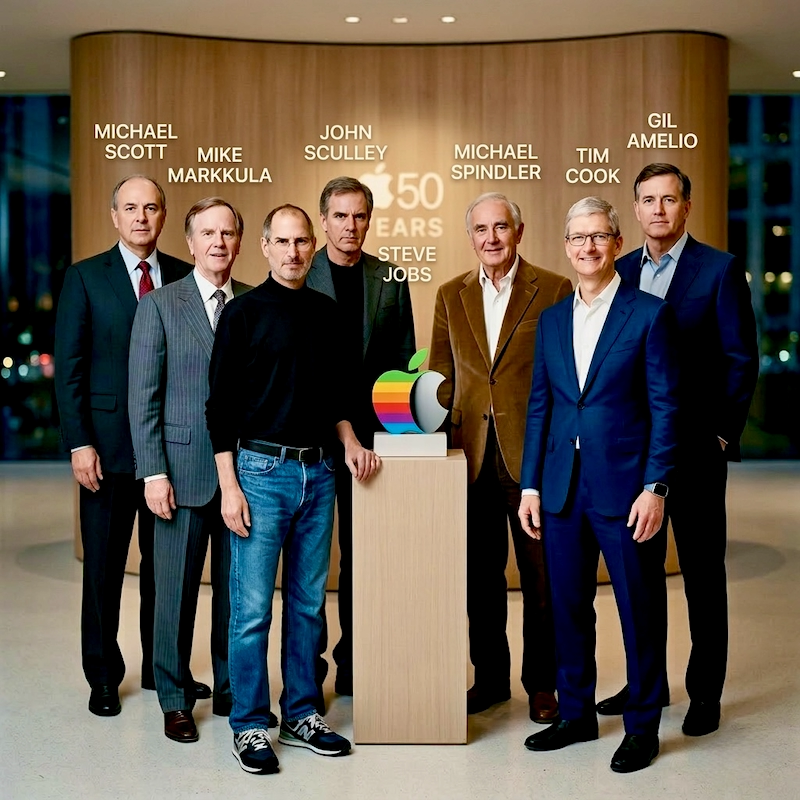
Apple's incredible 50-year journey from a Los Altos garage in 1976 to a multi-trillion-dollar global empire by 2026 is a story of extreme volatility, near-bankruptcy, and unprecedented technological triumphs. The company's trajectory has been entirely shaped by the uniquely different leadership styles of its seven Chief Executive Officers. Here is a detailed, era-by-era breakdown of the executives who built, almost destroyed, and ultimately resurrected Apple. Michael Scott (1977–1981): The "Adult Supervision" When Apple officially incorporated in early 1977, co-founders Steve Jobs and Steve Wozniak were brilliant, but they were in their early twenties and completely unequipped to run a rapidly scaling business. Recognizing this, Apple’s primary investor, Mike Markkula, recruited Michael "Scotty" Scott from National Semiconductor to serve as Apple's first official CEO. Scott’s mandate was simple: provide adult supervision to a company entirely run by hobbyists and hardware hackers. His primary achievement was transforming Apple from an informal club into a highly structured, operational corporation capable of mass production. Scott immediately instituted standard corporate practices that deeply clashed with the founders' countercultural ethos. He established formal departments, created strict reporting structures, and famously banned typewriters from the Apple offices, forcing all employees to use the company's own computers for word processing. He also implemented a company-wide badge numbering system based on the order employees were hired. In a move that permanently strained his relationship with Steve Jobs, Scott assigned employee badge #1 to Steve Wozniak and #2 to Jobs. When Jobs protested, Scott refused to budge, forcing Jobs to controversially claim badge #0. Despite the internal friction, Scott’s operational rigor was exactly what Apple needed to scale the massive success of the Apple II computer. His crowning achievement was expertly guiding Apple through its Initial Public Offering (IPO) in December 1980. It was the most highly anticipated public offering since the Ford Motor Company in 1956, and under Scott’s leadership, the IPO generated massive capital and instantly created over 300 millionaires, cementing Apple as a legitimate Silicon Valley powerhouse. However, Scott was notoriously hot-tempered and struggled with the chaotic nature of tech development. His tenure came to a dramatic and abrupt halt following an event known in Apple lore as "Black Wednesday." In February 1981, believing the company had become bloated and complacent, Scott unilaterally fired 40 employees without consulting the board. When asked about the brutal layoffs, he infamously stated that he would keep firing people until being CEO "became fun again." The board of directors, deeply alarmed by his volatility and the resulting crash in company morale, intervened immediately. Scott was demoted to vice chairman and officially pushed out of the company shortly after, ending the era of Apple's first adult supervision. Mike Markkula (1981–1983): The Stabilizer and Philosopher Often referred to as Apple's "forgotten founder," Mike Markkula was the original angel investor who wrote a critical $250,000 check in 1977 and secured the bank credit lines necessary to manufacture the first major run of Apple II computers. Following the chaotic and sudden exit of Michael Scott, Markkula—who had previously retired a millionaire from Intel at age 32—reluctantly stepped into the CEO role to stabilize the deeply shaken company. Markkula’s greatest and most lasting achievement was establishing Apple's foundational corporate ethos. A masterful marketer, he penned "The Apple Marketing Philosophy," a strict, three-point doctrine that would guide the company's product development for the next 50 years. The first point was Empathy: an intimate connection with the feelings of the customer. The second was Focus: the discipline to eliminate all unimportant opportunities. The third, and most famous, was Impute: the belief that people do judge a book by its cover, meaning that if Apple presented its software and hardware in a slipshod manner, it would be perceived as slipshod; if presented creatively and professionally, Apple would impute the desired qualities. During his tenure as CEO, Markkula oversaw the explosive, sustained commercial dominance of the Apple II, which had become a literal cash-printing machine for the company, heavily adopted by both the education sector and small businesses thanks to the VisiCalc spreadsheet software. However, he also had to navigate massive internal political storms. He oversaw the disastrous launch of the Apple III, which was plagued by hardware failures due to Steve Jobs's insistence on removing cooling fans. Furthermore, Markkula had to manage the bitter, toxic internal war between the teams developing the high-end Apple Lisa and the lower-cost Macintosh. Recognizing that Steve Jobs was too erratic to lead the Lisa project, Markkula removed him, inadvertently causing Jobs to take over the Macintosh division and launch a pirate-like rebellion within the company. Knowing he did not want to remain CEO long-term, Markkula spent much of his two-year tenure successfully hunting for a seasoned corporate executive who could take Apple to the Fortune 500 level. He ultimately set his sights on the East Coast, targeting the president of PepsiCo to take the reins, successfully stepping down in 1983 but remaining a vital force on Apple’s board until 1997. John Sculley (1983–1993): The Marketer and the Mac John Sculley was famously lured away from his position as president of PepsiCo by Steve Jobs with one of the most legendary pitches in business history: "Do you want to sell sugar water for the rest of your life, or do you want to come with me and change the world?" Sculley’s decade-long tenure as CEO was a fascinating paradox: it was a period of unprecedented financial growth for Apple, yet it also sowed the seeds of the company's near-destruction. Sculley’s defining early action was winning a vicious boardroom power struggle against Steve Jobs. By 1985, Macintosh sales had severely slumped, and Jobs’s erratic management was tearing the company apart. Sculley convinced the board to strip Jobs of his operational duties, leading to Jobs's resignation. With the visionary founder gone, Sculley leveraged his world-class, consumer-packaged-goods marketing expertise to transform Apple into a mainstream, highly profitable corporate brand. Under his leadership, Apple’s annual revenue skyrocketed from roughly $800 million when he joined to a staggering $8 billion by the end of his run. His greatest product achievement was ushering in the era of "Desktop Publishing." By aggressively pairing the Macintosh with the Apple LaserWriter printer and Aldus PageMaker software, Sculley gave the Mac a definitive, indispensable purpose in the creative and publishing industries, saving the platform from early failure. He also successfully guided the launch of the PowerBook in 1991, a massive hit that defined the modern laptop form factor by pushing the keyboard back and adding a palm rest and trackball. Furthermore, Sculley was a genuine technological visionary; he coined the term "Personal Digital Assistant" (PDA) and heavily promoted his "Knowledge Navigator" concept, accurately predicting mobile tablet computing decades ahead of time. However, Sculley’s tenure ultimately derailed due to an inability to manage complex engineering pipelines. He oversaw a disastrous proliferation of confusing Mac product lines (Performa, Centris, Quadra) that baffled consumers and destroyed retail relationships. Furthermore, his pet project, the Apple Newton PDA, was rushed to market in 1993 with deeply flawed handwriting recognition, becoming a massive commercial failure and a pop-culture punchline. Concurrently, Sculley failed to recognize the existential threat of Microsoft Windows 3.0 and 3.1, which offered a "good enough" graphical interface on vastly cheaper PC hardware. As Apple's market share began to violently contract and margins collapsed, the board of directors forced Sculley to resign in 1993. Michael Spindler (1993–1996): The Diesel and the Clones Nicknamed "The Diesel" for his relentless, grinding work ethic and formidable intellect, Michael Spindler stepped into the CEO role facing a monumental crisis. Apple's hardware was becoming obsolete, and Microsoft Windows was eating the personal computing market alive. Spindler, who had previously achieved massive success running Apple’s European operations and spearheading its successful entry into the complex Japanese market, was tasked with fundamentally modernizing the company's core technology. Spindler’s most significant and technically impressive achievement was successfully transitioning the entire Macintosh platform from aging Motorola 68000 series processors to the radically new PowerPC architecture. This was part of the "AIM" (Apple, IBM, Motorola) alliance designed to break Intel's monopoly. Executing a complete architectural shift without breaking legacy software compatibility is one of the hardest maneuvers in computer science. Spindler’s engineering teams pulled it off brilliantly, releasing the first Power Macs in 1994, which provided a massive, desperately needed performance boost that kept the Mac viable for heavy graphics and video workflows. However, Spindler’s legacy is heavily overshadowed by one of the most disastrous strategic decisions in Apple's history: authorizing the Macintosh clone program. Believing that Apple could no longer fight Microsoft's market share dominance as a closed ecosystem, Spindler officially licensed the Mac OS to third-party hardware manufacturers like Power Computing and Radius. The strategy catastrophically backfired. Instead of expanding the overall user base, the cheaper, faster clone machines simply cannibalized Apple's own high-margin hardware sales, bleeding the company's primary revenue stream dry. Simultaneously, Apple’s internal software development completely stalled. The project to build a modern, crash-proof operating system, codenamed Copland, descended into engineering chaos and missed every deadline, leaving Apple without a software path forward. Realizing the company was trapped in a financial death spiral, Spindler spent his final months desperately trying to sell Apple outright to IBM, Sun Microsystems, and Philips. When those acquisition talks ultimately collapsed due to disagreements over valuation, the board lost all faith in his leadership and abruptly ousted him in early 1996. Gil Amelio (1996–1997): The Turnaround Artist Gil Amelio, holding a Ph.D. in physics and boasting a sterling reputation as a corporate turnaround specialist from his time at National Semiconductor, was brought in to save a company that was literally weeks away from filing for bankruptcy. Amelio’s tenure as Apple CEO lasted barely 500 days, making him the shortest-serving chief executive in the company's history, but his brutal, unglamorous actions were absolutely critical to Apple's ultimate survival. Amelio arrived to find a financial catastrophe: a bloated workforce, millions of dollars in unsold inventory rotting in warehouses, and $1 billion in quarterly losses. His first achievement was stopping the immediate bleeding. He aggressively trimmed the fat, laying off thousands of employees and ruthlessly slashing dozens of internal R&D projects that had no clear path to profitability. Recognizing that Apple was out of cash, he leveraged his Wall Street credibility to raise $500 million in debentures, securing the vital capital required just to keep the lights on and meet payroll. Amelio’s most consequential achievement, however, was resolving Apple’s existential operating system crisis. With the internal Copland OS officially dead, Amelio knew he had to buy a modern operating system from the outside. He famously narrowed the choices down to Jean-Louis Gassée’s BeOS and Steve Jobs’s NeXTSTEP. After a series of technical bake-offs, Amelio orchestrated the $429 million acquisition of NeXT Computer in late 1996. This singular move accomplished two massive things: it provided Apple with the rock-solid, UNIX-based technological foundation that would eventually become Mac OS X (and later iOS), and it brought Steve Jobs back into the Apple fold as a "special advisor." Amelio, however, was a deeply uninspiring public speaker and lacked the product vision necessary to inspire consumers. This became painfully obvious during his rambling, disastrous multi-hour keynote at the 1997 Worldwide Developers Conference. Behind the scenes, Steve Jobs, recognizing Amelio's weakness, quietly orchestrated a ruthless boardroom coup. He convinced the board that Amelio could not lead Apple to growth, resulting in Amelio’s firing over the Fourth of July weekend in 1997, paving the way for the most famous second act in business history. Steve Jobs (1997–2011): The Visionary Architect When Steve Jobs returned to Apple as "interim CEO" in the summer of 1997, the company was a cultural joke and a financial wasteland, roughly 90 days from insolvency. Over the next 14 years, Jobs executed what is universally considered the greatest corporate turnaround in the history of global business. He didn't just save Apple; he systematically transformed it into the most culturally relevant consumer electronics company on earth, fundamentally altering how humanity interacts with technology across multiple industries. Jobs's immediate achievement was executing a ruthless simplification of the company. He instantly killed the disastrous Mac clone program, reclaiming Apple's hardware margins. He took a metaphorical scythe to Apple's bewildering product catalog, famously drawing a simple two-by-two grid on a whiteboard (Consumer/Pro, Desktop/Portable) and axing 70% of the company's hardware projects. To buy the time needed to innovate, he shocked the world by securing a $150 million investment and a public commitment to Mac software development from Apple's arch-rival, Microsoft. With the bleeding stopped, Jobs launched an unprecedented run of cultural and technological blockbusters. In 1998, he introduced the iMac G3, a candy-colored, translucent, internet-ready machine that eliminated legacy ports like the floppy drive in favor of USB. It signaled Apple's design renaissance and cemented his historic partnership with design chief Jony Ive. Jobs then mapped out his visionary "digital hub" strategy, positioning the Mac as the center of a user's digital life. This strategy required robust software, leading to the successful transition to the UNIX-based Mac OS X, finally giving Apple a modern, crash-proof operating system with the beautiful "Aqua" interface. The digital hub strategy birthed the iPod in 2001. Promising "1,000 songs in your pocket," the iPod didn't just dominate the MP3 player market; it resurrected the entire music industry. Through sheer force of will and negotiation, Jobs convinced wary record executives to unbundle albums and sell songs for 99 cents on the iTunes Store, proving that consumers would pay for digital media if the experience was seamless and legal. But Jobs's ultimate triumph, and the achievement that cemented his legacy as the architect of the modern digital age, was the 2007 unveiling of the iPhone. By combining a widescreen iPod, a revolutionary mobile phone, and a breakthrough internet communicator into a single device featuring a multi-touch interface, Jobs single-handedly destroyed the existing smartphone market dominated by physical keyboards and styluses. He followed this up in 2008 by launching the App Store, creating a multi-billion-dollar software economy overnight. In 2010, he proved critics wrong again with the iPad, establishing tablet computing as a mainstream consumer category. Beyond hardware, Jobs revolutionized retail. When he opened the first Apple Stores in 2001, analysts predicted a massive failure. Instead, by controlling the entire customer experience—from the architecture to the Genius Bar to the lack of commissioned salespeople—he created the most profitable retail spaces per square foot on earth. Jobs achieved all of this while privately battling a severe and prolonged illness. His management style was famously abrasive, demanding absolute perfection and utilizing his "Reality Distortion Field" to push engineers to achieve the impossible. He believed fiercely in the intersection of technology and the liberal arts, insisting that devices must be beautiful and intuitive, not just functional. When he passed away in October 2011, Steve Jobs left behind a company that was no longer just a computer manufacturer, but a foundational pillar of modern human life. Tim Cook (2011–Present): The Master Operator and Optimizer If Steve Jobs was the volatile, visionary architect who designed the rocket, Tim Cook is the master engineer who built the launchpad, optimized the fuel, and flew the rocket to the stars. Taking over as official CEO in August 2011, just six weeks before Jobs passed away, Cook faced immense global skepticism. Critics and Wall Street analysts loudly wondered how Apple could possibly survive, let alone innovate, without its chief visionary. Over his massive 15-year tenure leading up to the 50th anniversary, Tim Cook answered that skepticism by turning Apple into the most profitable and financially formidable company in human history. Cook’s foundational achievement lies in his absolute mastery of global logistics and scale. Joining Apple in 1998 after stints at IBM and Compaq, Cook had served as Jobs's Chief Operating Officer, where he built Apple’s world-class supply chain. He famously viewed inventory as "fundamentally evil," comparing it to dairy products that spoil within days. As CEO, Cook leveraged this incredibly responsive, just-in-time manufacturing network to scale the iPhone into a global juggernaut. Recognizing the demand for larger screens, he oversaw the launch of the iPhone 6 supercycle in 2014, capturing massive, unprecedented market share in Asia. Under Cook’s operational discipline, Apple commanded the vast majority of the global smartphone industry's profits, achieving market capitalization milestones previously thought impossible: crossing the $1 trillion, $2 trillion, and staggering $3 trillion marks. Crucially, Cook proved he could step out of Jobs's shadow by launching highly lucrative, entirely new product categories. In 2015, he oversaw the development and launch of the Apple Watch. While initially positioned as a fashion accessory, Cook masterfully pivoted the device into an indispensable health, fitness, and medical monitoring tool, making it the best-selling watch in the world. He subsequently introduced AirPods, creating a massive, multi-billion-dollar wearables division out of thin air that, on its own, generated more revenue than many Fortune 500 companies. In 2024, he led Apple into the highly complex era of spatial computing with the release of the Apple Vision Pro, planting the flag for the next decade of human-computer interaction. Perhaps Cook's most strategic and vital business pivot has been the aggressive expansion of Apple Services. Recognizing that the smartphone market would eventually saturate and hardware upgrade cycles would lengthen, Cook built a massive recurring revenue engine. By deeply integrating services like Apple Music, Apple TV+, Apple Arcade, iCloud+, and Apple Pay into the ecosystem, Cook locked users into the platform. By 2026, the Services division has become a financial titan, providing Apple with highly predictable, high-margin revenue that insulates the company from global supply chain shocks. Furthermore, Cook oversaw one of the most flawless and technically impressive transitions in computing history: moving the Mac lineup away from Intel processors to Apple's custom-designed M-series Silicon. This move integrated the Mac with the iOS ecosystem and gave Apple total, unprecedented control over its technological destiny, resulting in massive gains in performance and battery life. Culturally, Cook evolved Apple's public persona dramatically. Where Jobs was apolitical, Cook has been a highly public-facing CEO, championing user privacy as a "fundamental human right" and famously fighting the FBI over encryption backdoors. He pushed aggressively for environmental sustainability, driving Apple's supply chain toward total carbon neutrality by 2030, and advocated publicly for LGBTQ+ rights and social issues. Tim Cook's legacy is defined by replacing volatile micromanagement with collaborative, steady leadership. He proved that world-class operational execution and ecosystem lock-in can be just as powerful, and far more profitable, than pure product vision.
Part 1: The Startup Phase and the Struggle for Structure
Part 2: The Corporate Era and The Wilderness
Part 3: The Modern Titans