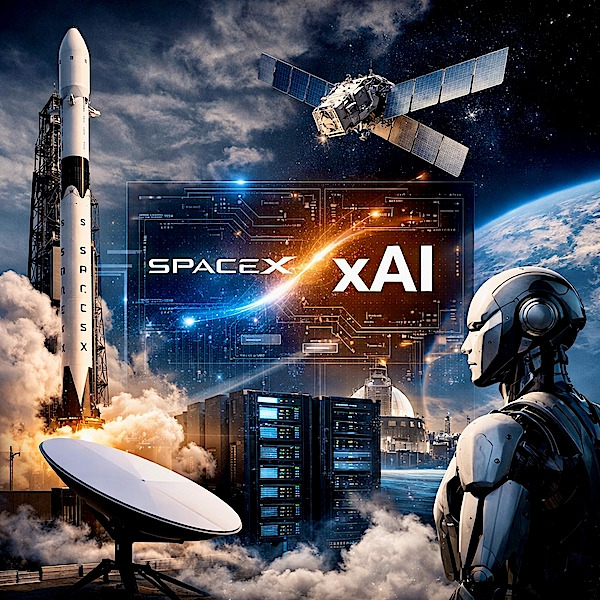
The merger of SpaceX and xAI has been pitched as destiny: rockets feeding satellites, satellites feeding data, data feeding artificial intelligence. It’s a story that sounds inevitable in an age that worships scale. Bigger systems, bigger dreams, bigger futures. Yet inevitability is often just ambition wearing a lab coat, and this merger carries real risks that deserve daylight. The first concern is focus. SpaceX earned its reputation by doing one thing ruthlessly well: reducing the cost of getting to orbit. Reusable rockets, rapid launch cadence, and a clear engineering north star made it an anomaly in aerospace. Folding an AI company into that mission bends the arc. Suddenly, rockets are no longer the end; they’re a means to support speculative AI infrastructure. That shift matters. Companies rarely fail from lack of vision. They fail from having too many visions at once, all competing for attention, capital, and executive oxygen. Financial gravity is the next issue. SpaceX has been a rare private company with tangible assets, recurring launch contracts, and relatively predictable demand. xAI, by contrast, lives in the capital-intensive, cash-burning world of frontier AI, where costs are enormous and profits are hypothetical. Merging the two blends stability with speculation. That doesn’t eliminate risk; it redistributes it. Investors who signed up for rockets may now be underwriting neural networks, whether they like it or not. Then there’s centralization. The merger concentrates launch capability, satellite networks, communications infrastructure, and AI platforms under one corporate roof. Vertical integration can be efficient, but it also narrows the ecosystem. Innovation thrives on friction between independent players. When too much of the stack belongs to one entity, experimentation becomes permission-based. The danger isn’t monopoly in the cartoonish sense; it’s monoculture. A single strategic misjudgment can ripple through multiple layers of global infrastructure at once. Governance shadows follow naturally. SpaceX already occupies a sensitive position, touching defense launches, national security payloads, and global communications. Adding advanced AI into that mix raises uncomfortable questions about oversight, accountability, and power concentration. Governments tolerate private dominance when roles are narrow and legible. They get nervous when one firm starts resembling a parallel state, complete with rockets, networks, and intelligence systems. There’s also a cultural mismatch worth noting. Aerospace engineering is slow, conservative, and allergic to failure for good reason: things explode. AI startups, by contrast, iterate fast, break often, and apologize later. Merging these cultures doesn’t automatically produce synergy. It can just as easily produce internal drag, where safety-critical engineering and hype-driven software development pull against each other like mismatched gears. Perhaps the most subtle risk is narrative drift. SpaceX’s power has always been its story: making humanity multiplanetary by solving hard physical problems. AI data centers in space, whatever their future potential, feel like a detour from that clarity. When a company’s story becomes abstract, trust erodes. Employees, partners, and investors begin to wonder not just how the work is done, but why. None of this means the merger is doomed. Ambition has always been the engine of spaceflight. But ambition without discipline is just expensive wandering. The SpaceX - xAI merger signals a future where technological domains collapse into each other, boundaries blur, and scale is mistaken for coherence. The risk is not that the vision is too bold. The risk is that it’s too crowded - too many grand ideas sharing the same launchpad, waiting for a countdown that may never quite reach zero.