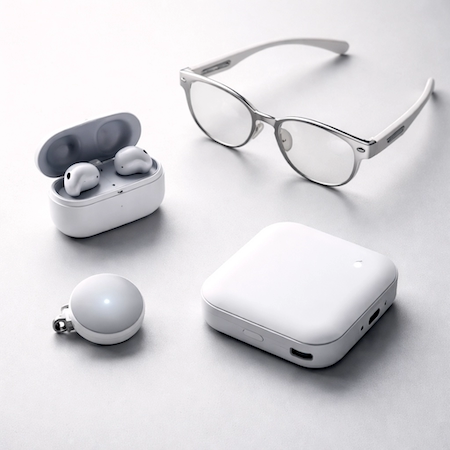
Imagine this: no slab of glowing glass in your hand. No endless scroll. No icon grid begging to be rearranged like digital furniture. Instead, there’s a small, quiet object—about the size of a deck of cards—resting in your pocket or purse. It doesn’t demand attention. It waits. Around you, lightly, almost politely, are voice-enabled earpieces. Not “headphones” in the DJ sense. More like a whisper network. They listen when spoken to. They speak when spoken back to. They do not shout. They do not ping. They do not glow unless invited. This is the form factor that makes sense for artificial intelligence. For decades, we’ve been forcing new intelligence into old containers. We crammed the internet into phones. We poured machine learning into notification systems designed for email and social feeds. The result has been friction: tools that are powerful but cognitively loud, omnipresent yet exhausting. A supercomputer that behaves like a needy toddler. AI doesn’t want a screen. It tolerates one. The most natural interface for intelligence—human or otherwise—is conversation. Speech. Timing. Silence. Context. A raised eyebrow, a pause, a follow-up question. The screen is a translation layer, not the source. We’ve been confusing the dashboard for the engine. A pocketable base station changes that equation. It becomes the gravity well: compute, connectivity, memory, identity. The heavy lifting happens there. The wearable pieces stay light, discreet, and human-scaled. No hot silicon in your ear. No battery anxiety wrapped around your skull. Just a relay—voice in, voice out. This architecture mirrors how we already live. Our phones spend most of their time not in our hands. They’re on tables, in bags, forgotten on chargers. Yet we’ve designed our entire digital world as if constant visual attention were a virtue. It isn’t. It’s a tax. A deck-of-cards computer paired with voice wearables flips the relationship. The device becomes ambient. Assistance becomes optional. Intelligence becomes interruptible. That’s the key word: interruptible. True intelligence doesn’t barge in. It waits for context. It knows when to speak and when to shut up. A voice-first AI, unshackled from the tyranny of screens, can finally practice restraint. It can answer questions without pulling you into an app. It can remind you of something without demanding a swipe. It can help you think without asking you to look. Design matters here. Profoundly. This can’t be another plastic puck with a blinking ring of authority. It has to feel neutral. Calm. Almost boring. The way a well-made notebook is boring. The way a good pen disappears when it’s doing its job. If this sounds like science fiction, remember: the smartphone itself once did too. So did wireless earbuds. So did talking to a computer and having it talk back without embarrassment. What’s different now is intent. The next computing shift won’t be about adding features. It will be about subtracting noise. A small object in your pocket. A quiet voice when you need it. Silence when you don’t. That’s not a downgrade from the smartphone era. It’s an evolution—one that finally acknowledges a simple truth we’ve been ignoring: The smartest tools don’t demand your attention. They respect it.