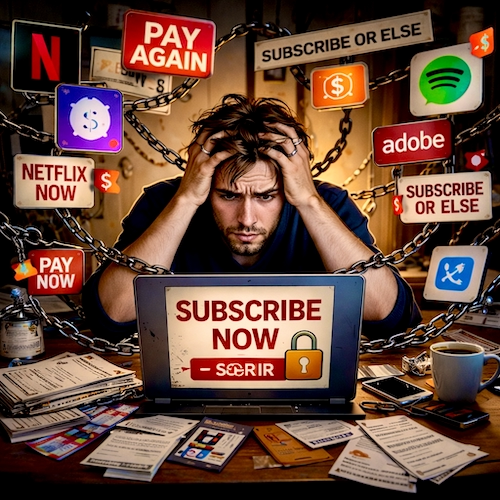
Subscription Fatigue: Why Not Owning Anything Is Making Us Poorer, Angrier, and Powerless
There was a time—not long ago in historical terms—when you bought a thing and it became yours. A book sat on your shelf. A record lived in its sleeve. Software came in a box, worked offline, and didn’t ask for rent. That world is being quietly bulldozed, replaced by an economy of perpetual toll booths. Welcome to subscription fatigue: the exhaustion that sets in when everything you “own” evaporates the moment you stop paying.
The subscription model is sold as convenience. In reality, it’s dependency with better marketing.
Music, movies, software, fonts, plugins, cloud storage, note apps, fitness platforms, cars, tractors, and now even heated seats—everything wants a monthly cut. The psychological trick is subtle but brutal: small recurring fees feel harmless in isolation, yet together they form a financial leech that never detaches.
This isn’t just about money. It’s about control.
When you stop subscribing, your files don’t simply sit there quietly. They rot. Proprietary formats lock you out. Projects refuse to open. Creative work—sometimes years of it—becomes a hostage note. Adobe is the most infamous example. Cancel Creative Cloud and your PSDs, AI files, and Premiere projects don’t vanish, but your ability to meaningfully edit them does. You’re allowed to look, not touch. That’s not ownership; that’s a museum ticket to your own labor.
Software historian Cory Doctorow calls this “enshittification”: platforms slowly degrade user value while increasing extraction, because users are trapped. Subscriptions are the perfect trap. Once your workflow depends on them, leaving becomes expensive, painful, or impossible.
The cloud was supposed to liberate us from hardware. Instead, it centralized power. Your documents now live on someone else’s server, governed by terms you didn’t read and cannot negotiate. Google has repeatedly shut down products with little notice—Google Reader, Google Play Music, Stadia—taking purchased or accumulated content with them. When a service dies, ownership dies with it.
This model reshapes how we think about permanence. Nothing feels settled. Nothing feels finished. Everything is provisional, rented, revocable. That uncertainty seeps into creative work especially. Why invest deeply when access itself is conditional? Why build an archive when the archive expires?
Historically, ownership enabled independence. Owning tools meant you could keep working regardless of market shifts, policy changes, or corporate collapse. Subscription culture reverses that. It ensures continuous revenue not by excellence, but by friction. The product doesn’t have to improve; it just has to remain inconvenient to leave.
Defenders argue that subscriptions lower upfront costs. That’s true—briefly. Over time, subscriptions are more expensive than one-time purchases, especially for long-term users. Underestimation is not a bug. It’s the business model.
The deeper problem is philosophical. Ownership anchors responsibility and agency. Renting everything turns citizens into tenants of their own lives. When access replaces possession, rights quietly become privileges. And privileges can be revoked.
There is nothing wrong with optional subscriptions. There is something deeply wrong with mandatory ones—especially when they hold your past work hostage. Files should not self-destruct because a credit card expired. Creative labor should not be leased back to its creator.
Subscription fatigue isn’t just annoyance. It’s the body recognizing a loss of autonomy.
Owning things isn’t nostalgia. It’s resilience.