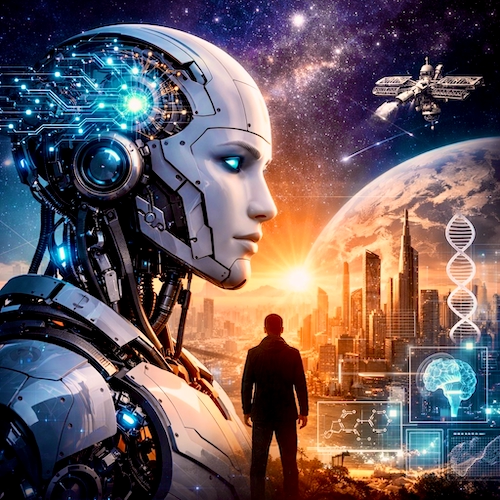
Artificial General Intelligence - AGI - is the moment machines stop being clever tools and start becoming true intellectual partners. Not faster calculators. Not better autocomplete. Minds that can learn, reason, and adapt across domains the way humans do. When that threshold is crossed, history doesn’t just turn a page. It changes the language it’s written in.
Today’s AI systems are specialists. They play chess, generate images, summarize documents, predict proteins. Each task requires careful training and guardrails. AGI is different. An AGI can learn any intellectual task, transfer knowledge between fields, and improve itself through experience. That distinction matters because intelligence is a force multiplier. Once it’s general, progress stops being linear.
The first seismic change will be acceleration of discovery. Scientific research is slow not because humans lack intelligence, but because we lack time, attention, and working memory. An AGI can read every paper ever published in a field, notice contradictions humans missed, design experiments, simulate outcomes, and iterate endlessly. Drug discovery that now takes a decade could take weeks. Climate models could move from probabilistic guesses to precise, actionable forecasts. Physics may finally reconcile theories that have stubbornly refused to shake hands for a century. This isn’t speculation - it’s extrapolation from what narrow AI already does in constrained environments.
Second, AGI will reshape work at a foundational level. Jobs built on routine cognitive labor - accounting, legal research, scheduling, diagnostics - won’t vanish overnight, but their economic gravity will collapse. At the same time, new roles will emerge: human-AI collaboration, value alignment, oversight, creative synthesis. The economic challenge won’t be mass unemployment so much as mass transition. Societies that adapt quickly will flourish. Those that pretend nothing is happening will fracture.
Third, education will undergo a quiet revolution. An AGI tutor can teach every student at their optimal pace, in their preferred style, with infinite patience. It won’t replace teachers; it will free them from being content dispensers and let them become mentors and guides. The factory model of education - one speed, one test, one outcome - will finally crack.
Then there’s creativity. AGI won’t “kill art.” That fear misunderstands art’s function. Art isn’t about technical execution; it’s about meaning. AGI will generate music, stories, paintings, and films effortlessly. Humans will respond by doing what they always do when tools improve: raise the bar. Authenticity, intention, and perspective will matter more, not less. The question will stop being can this be made? and become why should it exist?
The largest implication, though, is philosophical. AGI will force humanity to confront what intelligence actually is. If a machine can reason, learn, create, and explain itself, then intelligence is no longer a human monopoly. That realization will be unsettling and clarifying. We’ll have to decide what values we want encoded into minds that may one day surpass our own. Alignment, governance, and restraint will matter as much as innovation.
History is watching. And soon, something else will be too.